Eight Figures, Still Chapter One: Why HexStellar’s Founder Said No
Brayon Pieske says he declined an eight-figure initial offer in US dollars for HexStellar. His written statement explains the conviction and uncertainty behind the decision.

Brayon Pieske says he declined an eight-figure initial offer in US dollars to sell HexStellar because he believes the company has more to build. The company’s workload-specific Runtime results frame a broader ambition: more useful computing capacity with less energy, potentially reducing hardware investment and environmental impacts.
Brayon Pieske says he turned down an initial offer to sell HexStellar for an eight-figure sum in US dollars. His explanation carries both conviction about the company’s future and an unusually direct acknowledgment of the doubt that follows a decision of that size.
“Eight figures. That was the initial offer to sell HexStellar (HXS). I turned it down.”
Brayon Pieske, founder of HexStellar
In a written statement supplied for this feature on November 6, Pieske describes a choice to keep building while the company’s direction is still taking shape. He treats the offer seriously. He also believes it arrived before the work he wants HexStellar to do has fully emerged.
The statement comes in the same week as HexStellar’s latest public report on Runtime software running on NVIDIA Blackwell hardware. Together, they place a personal decision beside a technical proposition: how much more useful work can software make possible from a computing system’s available resources?
A serious offer, and a decision with a cost
Pieske speaks about the offer with respect.
“Huge respect to who made the offer. It was a serious number.”
Brayon Pieske
In his account, the decision turns on timing. He believes HexStellar is still early in the work that will define it.
“The offer priced what HXS was, not what it is becoming. Selling at that price would mean handing over the book while still writing Chapter 1.”
Brayon Pieske
Keeping the company means staying responsible for the decisions ahead: where the software proves most useful, which problems deserve attention, and how research becomes something customers can rely on. He describes the personal cost of that choice directly.
“This decision will keep me company for a while. It will cost sleep and keep asking if it was the right call. But every week the belief in what HXS can become grows stronger than the doubt.”
Brayon Pieske
The doubt and the momentum coexist. Pieske expects the decision to keep asking something of him, even as his confidence in the work grows.
Pieske says he has not yet decided on HexStellar’s commercial path. He is weighing a sale at a higher valuation against licensing the technology in return for royalties. In the licensing scenario, he says the licensee would need to be a large company.
The software proposition behind the conviction
One sentence in Pieske’s statement establishes the product category plainly: “HXS is software.”
HexStellar’s November 4 Blackwell report, updated November 5, concerns HexStellar Runtime on a single NVIDIA GeForce RTX 5090. Across six selected workload categories, the company reports 1.74× to 22.29× throughput (174% to 2,229% of baseline throughput) and 42.60% to 95.40% lower energy per operation, measured at the GPU level, against the baselines in its comparisons. The largest throughput and energy gains come from different comparisons. Read the workload results.
The stress workload makes the combination tangible: 2.98× throughput (298% of baseline throughput), 208 watts less measured GPU board power, and a temperature 11°C lower in the reported comparison. More work finished while the GPU’s measured power and temperature fell. The results remain specific to the tested workloads and environment. See the stress comparison.
Pieske also reports that independent validation has taken place under a restricted non-disclosure agreement. The evaluator and validation details remain confidential. HexStellar’s published Blackwell report provides the company-reported figures available for readers to examine.
Beyond the results HexStellar has published, Pieske describes a broader body of unpublished proof-of-concept work:
“Hundreds upon hundreds of proofs of concept have already been carried out with real drones, blockchain, IoT, GPUs, TPUs, smartphones, Meta smart glasses and much more. We repeated tests many times, always trying to disprove the results. We just haven’t published them.”
Brayon Pieske, translated from Portuguese
The Runtime measurements in this feature come from the published Blackwell comparisons.
The practical distinction is straightforward. Throughput describes how much work finishes in a given time. Energy per operation describes the electricity used for a completed unit of work. Improving both can matter to a team that needs additional computing capacity within a fixed schedule or energy budget.
The wider energy question is substantial. The International Energy Agency’s April 2026 outlook projects that global data-centre electricity consumption will rise from about 485 terawatt-hours in 2025 to 950 terawatt-hours in 2030. The agency also describes how efficiency gains interact with growing use and more demanding applications. IEA: Key Questions on Energy and AI.
For an individual computing team, the useful starting point is smaller and more immediate: identify the work that needs to finish, measure what it consumes, and establish whether software can improve that result. A shorter job can leave room for another job. A lower energy requirement can make a limited operating budget go further.
More capacity before the next hardware purchase
More useful work from installed hardware can also change the timing of the next purchase. If a team can meet growing demand with the GPUs it already owns, it may be able to postpone or reduce capital expenditure, or CapEx, on additional GPUs and the power and cooling infrastructure needed to support them. This is the investment question behind the efficiency figures: how much demand can the current installation serve before expansion becomes necessary?
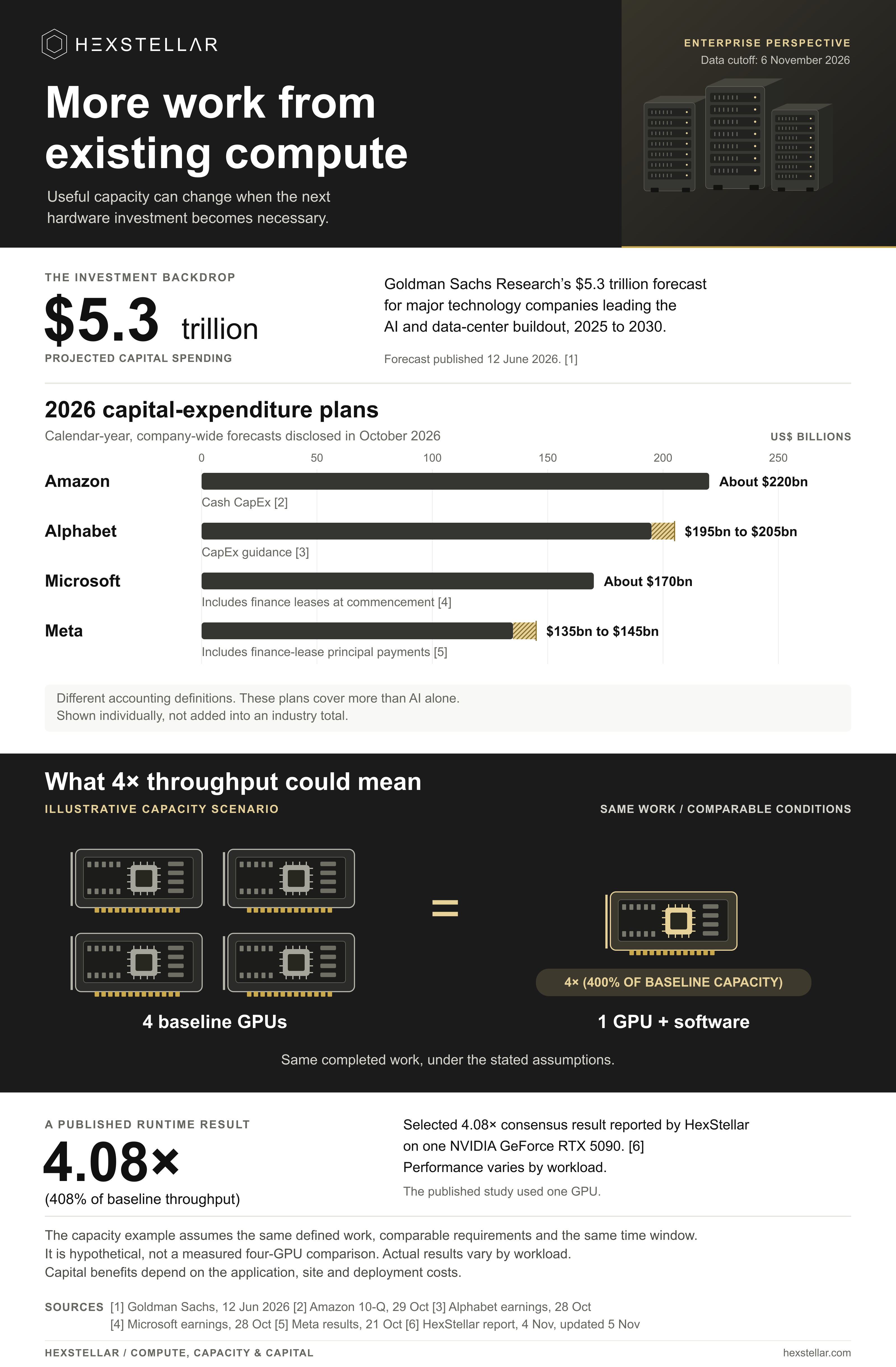
That question is becoming more expensive for the industry to answer. In a June 12, 2026 analysis, Goldman Sachs Research projected $5.3 trillion in combined capital spending from 2025 through 2030 by the large technology companies leading the AI and data-center buildout. The forecast captures the scale of the investment cycle in which operators are deciding how much new capacity to finance. Goldman Sachs: Data-center financing.
The companies’ own forecasts make that investment cycle more concrete. Each figure below is a company-wide capital-expenditure plan, with its stated period and reporting basis.
Scroll horizontally to view all columns.
| Company | Period | Planned capital expenditure | Official disclosure and basis |
|---|---|---|---|
| Amazon | Calendar 2026 | About $220 billion | Q3 2026 Form 10-Q: cash CapEx. |
| Alphabet | Calendar 2026 | $195 billion to $205 billion | October 28 earnings call: CapEx guidance. |
| Microsoft | Calendar 2026 | About $170 billion | October 28 earnings call: includes full finance-lease principal at commencement. |
| Meta | Calendar 2026 | $135 billion to $145 billion | October 21 results: includes finance-lease principal payments. |
The plans cover broader spending than AI alone and use different accounting definitions, so the table presents them separately.
Oracle reported about $28.5 billion in capital expenditures in its first quarter of fiscal 2027, covering June through August 2026. That quarterly result is presented separately from the calendar-year spending plans above. Oracle: First-quarter fiscal 2027 results.
Money is only part of the constraint. JLL’s January 2026 global outlook reported that average waits for grid connections in primary data-center markets exceeded four years. It also forecast $11.3 million per megawatt as the average global construction cost for 2026, covering shell and core and excluding the tenant’s IT fit-out. JLL: Global Data Center Market Outlook.
These figures put the software question in a wider business context. If an operator can complete more of its required work within an existing site’s equipment, power and cooling limits, it may gain time before the next expansion. The value would depend on the application and the site, but it could involve capital commitments and construction schedules as well as electricity bills.
The public report’s consensus comparison reached 4.08× (408% of baseline throughput) in one selected result. For illustration, suppose a chosen workload maintains 4× capacity (400% of baseline capacity) for the same defined work and comparable requirements. One GPU could then complete as much of that work in the same time window as four GPUs performing at the baseline rate. This is a hypothetical comparison of completed work, not a measured four-GPU test; actual results vary by workload.
Whether that changes a purchase depends on demand, the site, and deployment costs. The potential is to buy later, buy less, or use available capacity for more work, with any projected savings calculated for the intended site.
Energy, water and everyday computing
Reducing energy per useful task can matter beyond the electricity bill. Where the electricity supply has a carbon footprint, less electricity for the same work can lower operational emissions. Lower operating power can also ease the heat burden on cooling systems, with the outcome shaped by the site’s equipment and energy supply.
Water makes those local conditions tangible. In its 2024 report, Lawrence Berkeley National Laboratory estimated that US data centers consumed 66 billion liters of water directly in 2023, with further water consumed in generating their electricity. Lower cooling demand and reduced electricity requirements may therefore save water, depending on how the site is cooled and its power is generated. Some cooling designs trade lower electricity use for higher water consumption, making it important to assess both together. LBNL: Data-center energy, water and emissions.
For HexStellar, the public GPU-level energy results are a reason to test these benefits in complete applications, including their electricity and cooling needs. The IEA’s analysis also shows why demand must stay in view: growth in computing use can outpace efficiency gains. IEA: Energy efficiency and growing AI demand.
For personal devices such as phones, laptops and wearables, Pieske wants to investigate the environmental benefits of more useful work from a battery charge and less heat during use. Evaluating those benefits means testing the devices and everyday applications people rely on.
The European Commission explains that efficient smartphones and tablets can run longer for a given battery capacity, reducing how often they need recharging. It also links longer device use to fewer replacement purchases and lower production impacts, when the number of devices in use remains the same. European Commission: Smartphones and tablets.
Pieske also wants to investigate whether the lower temperatures reported in the Runtime comparisons could help equipment remain useful for longer, a research question that would require further testing.
Where the next chapter becomes practical
The opportunity Pieske is choosing to pursue comes into focus at the level of a real application. A compute-intensive batch may need to finish within an overnight window. A team operating under an energy limit may need to complete more work within that allowance. Software efficiency becomes valuable when it changes what that team can accomplish.
Pieske also sees a dual-use future for HexStellar, with applications in enterprise and defense.
HexStellar’s published Runtime evaluation process offers a way to examine that value: scoped, local, on-site, air-gapped testing under an agreed protocol and NDA, with the workload, baseline, outputs, and useful outcome defined for the evaluation. For an interested team, the starting point is its own computing requirement and a clear measure of success.
This is the space between a promising result and a useful business: finding the applications where the improvement matters, understanding what users need, and doing the work to deliver it. Continuing with HexStellar gives Pieske more time to explore that space. It also means remaining accountable for what comes next.
Proof-of-concept discussions remain open
Pieske says HexStellar remains open to proof-of-concept discussions and has not entered into an exclusivity agreement with any party. He believes that window may not remain open for long.
Pieske explains that direct Runtime proofs of concept are arranged locally, on site, in an air-gapped environment to protect the confidentiality of sensitive proprietary technology. This is a policy for controlled evaluation. HexStellar coordinates the host hardware, workload, local access and test logistics with the participating team before testing; Runtime is not handed over as an online self-service trial.
Teams with a concrete workload to test can discuss a Runtime proof of concept with HexStellar, using the scoped, on-site evaluation process described above. The invitation is to bring a real computing requirement, agree on the conditions, and establish what a useful result would look like.
Pieske closes his statement with gratitude for the opportunity to continue:
“There is a lot of Chapter 1 left to write. I am grateful to still be the one holding the pen.”
Brayon Pieske
He ends with a return to work: “Back to the trenches.”
For Pieske, the next chapter begins with the work already in front of him.
Source note: This company newsroom feature draws on Brayon Pieske’s written statement and clarifications supplied on November 6, 2026, HexStellar’s linked public Runtime report, the IEA outlook, Goldman Sachs and JLL investment research, the companies’ linked financial disclosures, LBNL’s data-center analysis, and the European Commission’s device guidance cited above. Quotations, the account of the offer, the commercial options under consideration, the description of confidential validation, the account of unpublished proofs of concept, the current availability and exclusivity statements, and the research interests in equipment life and personal devices come from Pieske.
Discuss the Runtime research
Contact HexStellar with questions about this research or a scoped Runtime evaluation. An evaluation should define its workload, environment, measurements, and verification criteria.